
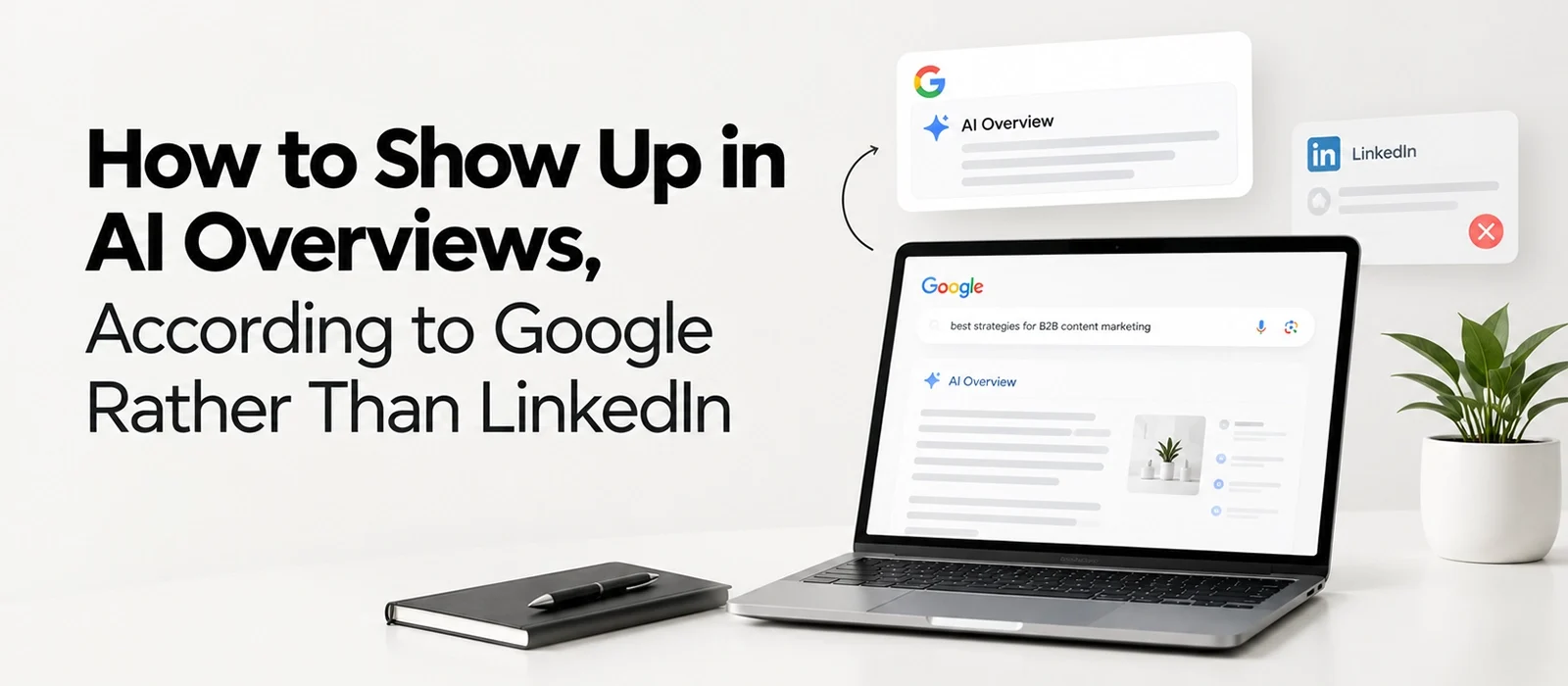
There is no separate optimisation for AI Overviews. Google says so in its own documentation: to be eligible as a supporting link in AI Overviews or AI Mode, a page must be indexed and eligible to appear with a snippet, and there are no additional technical requirements.
That single sentence removes most of what is being sold as AEO and GEO consultancy in 2026. What remains is the ordinary work, done properly — which is harder to sell and considerably more valuable.
What the acronyms mean
- AEO — answer engine optimisation. Being the source an answer is built from, rather than a link somebody clicks.
- GEO — generative engine optimisation. The same idea aimed at generative systems: AI Overviews, AI Mode, ChatGPT Search, Perplexity.
Both describe a real shift in behaviour. Neither describes a separate discipline, and treating them as one is how agencies end up charging for a rebranded content audit.
What Google actually published
Three documents are worth reading in full rather than through somebody’s summary:
- AI Features and Your Website — how AI Overviews and AI Mode treat your pages, and what controls you have.
- Optimizing for generative AI features on Google Search — published in 2026, and blunt: the best practices for SEO remain relevant, because the AI features are rooted in core Search ranking and quality systems.
- Top ways to ensure your content performs well in Google’s AI experiences — the practical version.
The consistent message across all three: same systems, same signals, same work.
So what does change?
The technical requirements do not change. The economics do, in two ways that matter.
1. The click is no longer guaranteed
A searcher who gets a complete answer on the results page has no reason to visit anybody. That hits informational queries hardest — “what is”, “how does”, “why” — and commercial queries least, because someone who wants to buy still has to reach a page that sells the thing. If you sell something, your exposure is lower than the headlines suggest. If you run an ad-funded blog, it is higher.
This is why any 2026 traffic forecast needs an explicit allowance for searches that end without a click. Our SEO traffic value calculator has a field for exactly that, and what a Google ranking is worth works through the arithmetic.
2. Being cited is worth something on its own
Your name appearing as the source behind an answer has value even without a click, in the same way a billboard does. It is harder to measure and easier to dismiss, and dismissing it would be a mistake.
What to do, in order
Be crawlable and snippet-eligible
The baseline requirement. A page blocked in robots.txt, marked noindex, or carrying nosnippet cannot be cited. Check this before anything else, because a surprising number of “we are invisible in AI search” problems are a max-snippet directive somebody set in 2019 and forgot.
Answer the question in the first paragraph
Not after eight hundred words of context. A machine extracting an answer takes the clearest, earliest, most self-contained statement it can find. So does a human skimming. Notice that this article opens with its conclusion — that is the technique, not a stylistic accident.
Make one page own one question
A page trying to cover five questions answers none of them well enough to be quoted on any. Split them. Five focused pages that link to each other also build the topical coverage that helps all five rank, which is the same reason these articles cross-link the way they do.
Write in extractable units
A definition in one sentence. A number with its unit and its period attached. A table where a comparison belongs. A process as a numbered list. This is not “writing for robots” — it is the structure a careful editor would ask for anyway, and it is what makes a passage quotable.
Be the kind of source worth citing
First-hand data, a named author who did the work, dates on claims, and a real organisation behind the page. Content assembled from what already ranks has nothing to add to a synthesis of what already ranks.
Use structured data where it fits the content
Product, FAQ, Article, Organisation, LocalBusiness. It does not buy you a citation, but it removes ambiguity about what a page is and what the numbers on it mean. Mark up what is genuinely on the page and nothing else.
What not to buy
- “AI Overview ranking guarantees.” Nobody controls placement, including the people selling this.
- “LLM-optimised content” at scale. Thin content generated in bulk is the thing the systems are built to discount.
- “Special AI schema.” There is no such thing. The structured data types are published and public.
- Anything promising a fixed timeline. Same red flag as it has always been. Google’s own guidance on hiring an SEO lists ranking guarantees first among the warning signs.
How to measure it
Imperfectly, which is the honest answer. Search Console does not break out AI Overview impressions separately. What you can do:
- Track impressions and clicks for informational queries against commercial ones. A widening gap is the fingerprint.
- Watch average position against click-through rate. Position holding while CTR falls means something above you is absorbing the click.
- Check referral traffic from AI tools in analytics. It is small, it is growing, and it is measurable.
- Search your own key questions occasionally and see who gets cited. Unscientific, and more informative than most dashboards.
Frequently asked questions
Do I need a separate AEO strategy?
No. You need your existing SEO done well, with answers written early and clearly. If an agency proposes AEO as a separate line item, ask which specific tasks differ from the SEO they are already charging you for.
Should I block AI crawlers?
Blocking Google’s crawler removes you from Search, not just from AI Overviews. Separate crawlers for other AI products can be blocked individually, and that is a business decision about whether citation without clicks is worth it to you. For most businesses selling something, it is.
Has traffic actually fallen?
It depends entirely on your query mix, which is why aggregate industry numbers are useless to you. Pull your own data from Search Console, split informational from commercial, and compare the two trends. That takes an afternoon and beats any survey.
Does structured data get me into AI Overviews?
Not directly. It helps machines interpret the page without guessing, which is worth doing regardless. Anyone presenting schema markup as an AI ranking lever is overselling it.
Where to go from here
The work is the work: crawlable pages, answers up front, one question per page, real expertise behind it. That is what our SEO service does, and it is what it did before the acronyms arrived. If you want to know whether your pages are eligible in the first place, that is the first thing a free audit checks.
[…] go through this in detail in how to show up in AI Overviews. The short version: the practical answer to “how do I optimise for AI search” is the […]