
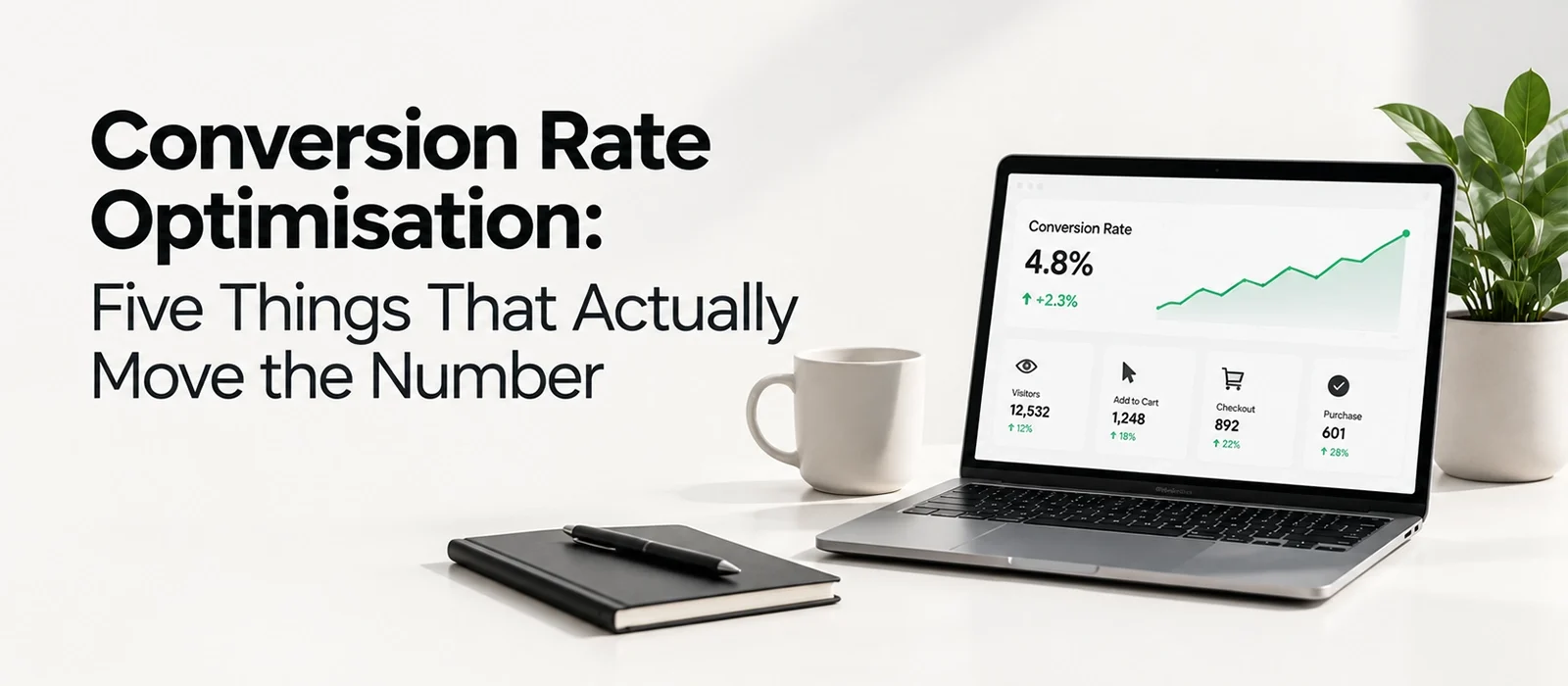
Conversion rate is the only lever that improves every channel at once. Cut your cost per click by 20% and paid search gets cheaper. Raise your conversion rate by 20% and paid search, organic search, email and the link somebody sent a friend all get 20% better, permanently, for the same spend.
It is also the lever most often ignored, because it lives on the website and the conversation is usually happening inside an ad account.
What the number is, and what it is not
Conversion rate = conversions ÷ sessions, for a defined conversion and a defined segment.
Three things make a reported conversion rate meaningless:
- Mixing traffic sources. Branded search converts several times better than cold paid traffic. A site average blends them into a figure that describes no actual campaign.
- Mixing devices. Mobile usually converts lower than desktop. If your mobile share moves, your average moves, and nothing has changed.
- An undefined conversion. A purchase, an enquiry and a newsletter signup are not the same event and should never share a number.
Before optimising anything, split the figure by source and device. The problem is normally in one segment, not spread evenly.
1. Remove friction from the checkout or the form
The largest single opportunity on most sites. Baymard Institute’s review of 50 cart abandonment studies puts the average abandonment rate at 70.22%. Seven in ten people who wanted the thing enough to add it to a basket leave before paying.
The usual causes are mundane and fixable: unexpected costs appearing late, a forced account creation, too many fields, no visible security reassurance, a delivery date that is never stated. Each one is a decision somebody made, and each one can be unmade.
For a lead form, the equivalent is field count. Every field you add costs you submissions. Ask for what you need to have the first conversation and nothing else — our own enquiry form asks for five things, and the budget range is there because it saves both sides a call, not because it qualifies anyone out.
2. Make the page fast
Speed is not a ranking tiebreaker you can ignore; it is a conversion input with measurable revenue attached. Google’s Core Web Vitals set the thresholds: Largest Contentful Paint under 2.5 seconds, Interaction to Next Paint under 200 milliseconds, Cumulative Layout Shift under 0.1.
The published case studies are specific. QuintoAndar reduced INP by 80% and saw conversions rise 36% year on year. redBus improved INP and increased sales by 7%. We look at this in more detail in what page speed is worth in money.
3. Say the same thing the ad said
Someone clicks an ad for “waterproof hiking boots, free returns” and lands on a category page listing four hundred shoes. The promise and the page do not match, and the visitor leaves before deciding you were wrong — they leave because they cannot tell whether you were right.
Match the headline to the ad. Repeat the specific offer. Send traffic to a page about the thing that was advertised. This single change often outperforms months of button colour testing, and it costs one afternoon.
4. Answer the objection on the page
Every purchase has a reason not to. How long does delivery take, what happens if it does not fit, is this company real, who else bought this, what does it cost in my currency. If the answer is not on the page, the visitor supplies their own, and it is never favourable.
For a new business without reviews this is harder and more important. You cannot show a five-star average you have not earned. You can be specific about what happens next, state your terms plainly, name the person who will do the work, and remove the risk from the decision. Concrete beats impressive.
5. Test, but test properly
Most sites do not have the traffic for reliable A/B testing. Detecting a 10% relative improvement at a 3% base rate needs thousands of conversions per variant. Below that, a test that “wins” is usually noise, and acting on noise is worse than not testing.
Under that threshold, use qualitative methods instead. Nielsen Norman Group’s long-standing finding is that testing with five users surfaces most of a design’s important usability problems, and that many small tests beat one large one. Five people attempting to buy something while you watch will find more in an hour than a month of underpowered split tests.
What conversion rate is worth, in money
Take a site spending $5,000 a month at $0.80 a click: 6,250 visits, 2% conversion, 125 orders, $60 average order — $7,500 revenue.
Raise conversion to 2.5% and the same spend produces 156 orders and $9,375. That is $1,875 a month, or $22,500 a year, from one change to the website, with no extra media spend. The same uplift applied to organic traffic costs nothing extra there either.
Run the figures for your own site with the ad budget planner — it shows exactly what a half-point of conversion rate is worth against your revenue target. If you would rather check whether your current spend is profitable at all, start with break-even ROAS.
Frequently asked questions
What is a good conversion rate?
The same answer as every other benchmark question: it depends on what you sell, at what price, to what traffic. Two to three percent is commonly cited for ecommerce, but a $2,000 product converting at 0.4% may be far healthier than a $12 product converting at 5%. Compare yourself to your own last quarter.
Should I hire a CRO specialist or fix the site?
If you have never fixed the obvious problems, fix them. Specialist testing programmes earn their money after the basics are done, not instead of them. Most sites we audit have three or four unambiguous issues that need no test to justify.
How long before I see a result?
Friction and speed fixes show up in days. Messaging changes take a few weeks to read reliably. Anything requiring a statistically valid test takes as long as your traffic takes, and no longer is not an option.
Where to go from here
Start by splitting your conversion rate by source and device — the problem is almost never evenly spread. Then fix friction, then fix speed. That sequence is what our web design and conversion work follows, and the first pass is part of a free audit.
[…] Sending every ad to the homepage. The homepage answers no specific question. A page about the advertised thing converts several times better, which is the cheapest improvement available — see conversion rate optimisation. […]
[…] guess. A strong hook with weak conversion means the promise and the landing page disagree — see conversion rate optimisation. A weak hook means recut the opening and keep everything […]
[…] The prospect feels lost and immediately hits the back button. As we demonstrated in our guide on conversion rate optimization basics, maintaining a strict 1-to-1 message match between search intent and landing page copy is […]