
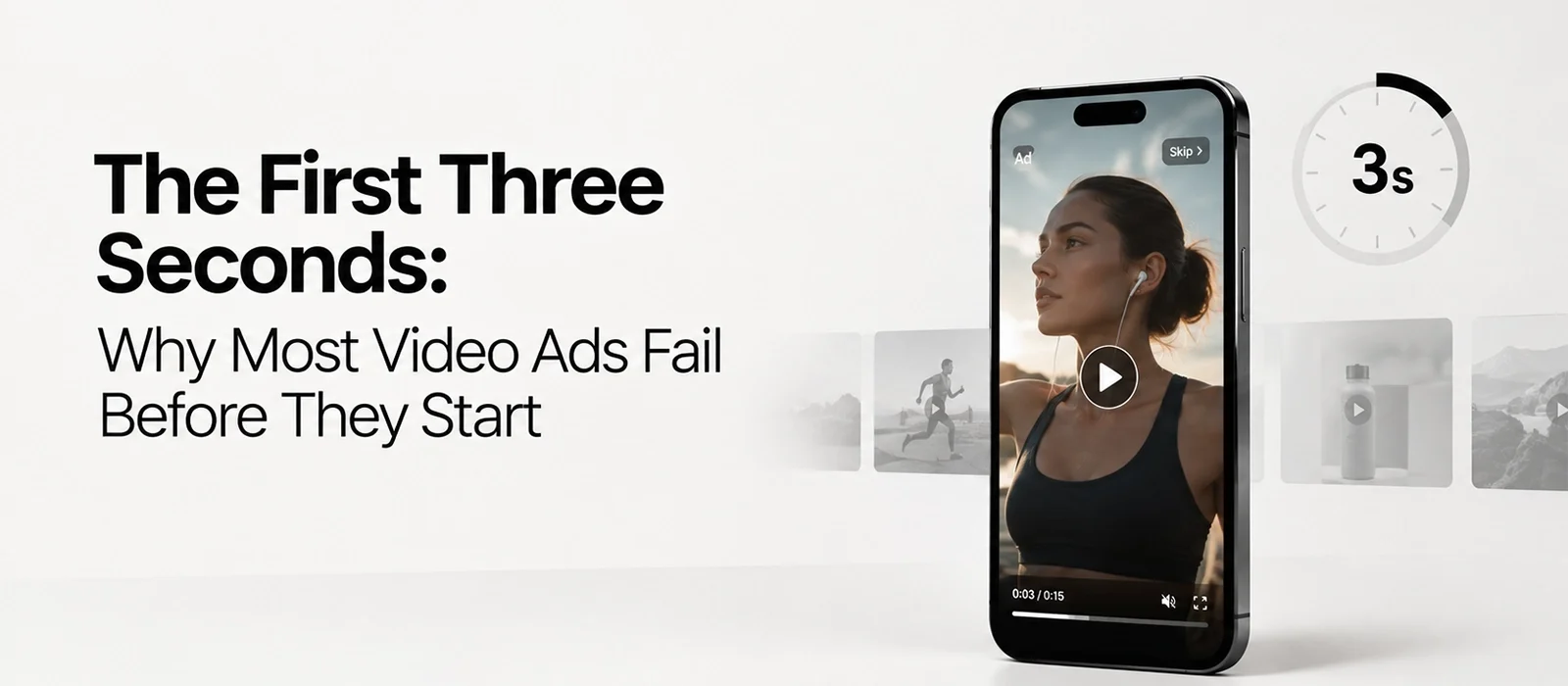
A video ad has to earn its second second. Nobody chose to watch it. It arrived between a friend’s photo and a video they did want, and the thumb is already moving. Everything that decides whether the ad works happens before most brand videos have finished their opening animation.
Build for the format people are actually in
Meta’s own best practices for mobile video ads come down to two instructions repeated in different words: hook people quickly, and make sure they can see what you mean without sound.
The format specifics matter more than they look. Meta reports that Reels ads built in 9:16 with audio and key elements kept inside the safe zone achieved 34.5% lower cost per result than image ads in the same placement. Vertical is not a stylistic preference. A square video in a vertical placement wastes a third of the screen you paid for, and puts your text where the interface covers it.
What the first three seconds has to do
One job: make stopping feel worth it. Four openings that do it, roughly in order of how often they work:
Show the problem, not the product
Someone struggling with the thing your product fixes. Recognition is faster than comprehension — the viewer sees themselves before they have read anything.
Start at the result
The finished room, the clean surface, the before-and-after already halfway through. Curiosity about how it happened buys you the next five seconds.
Say the specific thing
“Your ads are losing money at 3x ROAS” stops the right person immediately and lets everybody else scroll, which is exactly what you want — you pay for both.
Move something in frame
Hands doing something, an object entering, a cut on the first beat. A static opening frame reads as an advertisement before any words are processed.
What does not work, reliably: a logo animation, a slow establishing shot, a title card, or anybody saying “hi guys”. Those are the conventions of content people chose to watch.
Assume the sound is off
Most feed video starts muted. If your message lives in the voiceover, most of your audience never receives it.
- Caption everything, burned in rather than relying on platform auto-captions.
- Put the claim on screen as text, in the first two seconds.
- Design for sound-off, reward sound-on. Music and voice should improve the ad, never carry it.
- Keep text large and high-contrast, inside the safe zone so the interface does not cover it.
Length
Short enough that the point lands before attention goes, long enough to make the point. In practice:
- 6–10 seconds — one idea, one product, cold audience. The workhorse.
- 15–30 seconds — demonstration, before-and-after, a named objection answered.
- Over 30 seconds — only for warm audiences who already know you, or genuinely interesting content.
A thirty-second ad where the point arrives at second twenty is a ten-second ad with twenty seconds of waste in front of it.
What to measure
Do not judge a video ad by views. Judge it in three places:
- Hold rate at 3 seconds. The hook’s own score. A poor number here means nothing further in the edit matters.
- Hold rate at 15 seconds, or completion. Whether the middle earns its place.
- Cost per acquisition. The only one that pays anybody. An ad with a brilliant hold rate and no conversions is entertainment you funded.
The first two tell you where the ad fails, which is how you fix it rather than guess. A strong hook with weak conversion means the promise and the landing page disagree — see conversion rate optimisation. A weak hook means recut the opening and keep everything else.
Produce for iteration, not for the edit
The expensive mistake is treating a video ad as a finished film. Shoot so that you can recut:
- Film several openings for the same body. Three hooks and one middle gives you three ads.
- Keep the project file organised so a new hook is an hour’s work, not a reshoot.
- Shoot vertical natively. Cropping from horizontal loses framing you cannot get back.
- Capture more B-roll than the edit needs. It is free at the time and expensive later.
That is how our video editing is set up: fewer polished films, more variations that can be tested and replaced. Creative testing covers how many you need and how to judge them.
Frequently asked questions
Does the video need to look professional?
It needs to look deliberate. Phone footage that is well lit, in focus and well cut regularly beats expensive production that looks like an advert, because it looks like the rest of the feed. Sloppy is a different thing from informal.
Should the same video run on Meta and TikTok?
Vertical footage travels, and the opening rarely does. Different audiences in different moods need different hooks. Recut the first three seconds per platform and keep the body.
How often do video ads need replacing?
When performance decays, which on a small audience can be a few weeks. Watch frequency and cost per acquisition together — rising frequency with rising cost means the audience has seen it enough.
Can one video carry a whole campaign?
Briefly. Then it fatigues, and having only one leaves you with nothing to rotate to. Plan for a small library rather than one hero.
Where to go from here
Open your best-performing ad and watch the first three seconds with the sound off. If you cannot tell what is being offered and to whom, that is the fix, and it is an edit rather than a reshoot. We do this work as part of video editing and alongside paid advertising, so the creative and the media buying are not arguing with each other.
Leave a Reply