
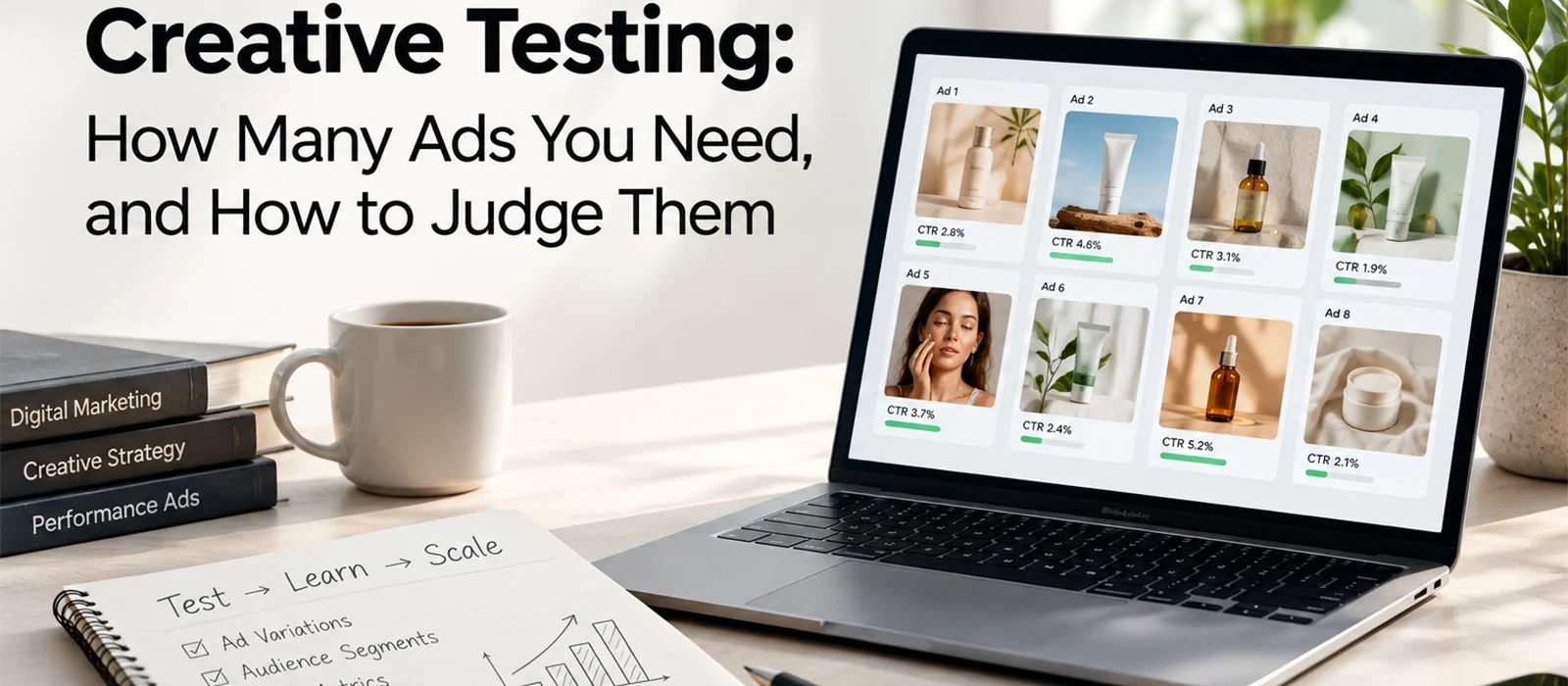
Creative decides more of your paid social performance than targeting does. The platforms have taken most of the targeting decisions away from you — Meta’s broad audiences and Google’s Smart Bidding both work out who to show ads to better than you can. What you still control is what they see.
Which makes creative testing the main job, and instinct a poor way to do it.
Test one variable at a time, and make it a big one
Two ads differing in headline, image, colour and call to action teach you nothing when one wins. You cannot tell which change did it, so you cannot repeat it.
Test the variables that move results, roughly in order:
- The angle. Problem-led, result-led, price-led, objection-led. The largest differences by far.
- The format. Static, video, carousel, user-generated style.
- The hook. First three seconds of a video, or the first line of a static. See the first three seconds.
- The offer. Free delivery against ten percent off against a bundle.
- Everything else. Button colour is on this list and it is at the bottom for a reason.
How many ads
Enough to give the platform options, few enough that each gets real delivery. For a small budget:
- 3 to 5 active creatives per ad set. More than that and the budget spreads too thin for any of them to leave the learning phase.
- 2 to 3 new ones a month. Enough to replace what fatigues without disrupting what works.
- One angle at a time. Three variations of one idea beat one variation of three ideas, because you learn whether the idea works.
The arithmetic is the constraint. If a conversion costs $25 and you want thirty per variant to judge it, that is $750 per variant. Five variants is $3,750 — more than many monthly budgets. Below that threshold, judge on leading indicators and accept that you are reading signals rather than proving results.
Judge in the right order
Different metrics fail at different points in the funnel, which is what makes them useful:
| What is weak | What it tells you | What to change |
|---|---|---|
| Hold rate at 3s | The hook is not stopping anyone | Recut the opening only |
| Click-through rate | They watched, they were not persuaded | The offer or the claim |
| Landing page conversion | The ad wrote a cheque the page did not honour | Match the page to the ad |
| Cost per acquisition | It works but not at a price you can pay | Check against break-even first |
That last row is the one people skip. An ad is not bad because its cost per acquisition is high; it is bad because its cost per acquisition is above what your margin can carry. Work out that ceiling with the CAC and LTV calculator before judging anything.
Give it long enough, and no longer
Automated bidding re-enters a learning period after significant changes, and results during learning are not results. Meanwhile, judging on the first two days rewards whatever happened to get cheap impressions on a Tuesday.
A workable rule: leave a new creative alone for the shorter of one week or fifty conversions, unless it is spending badly with nothing at all to show. Then decide once, decisively, and move on.
Keep a record, or you will test the same thing twice
Every team that skips this repeats a losing angle within six months. A single sheet is enough: date, angle, format, hook, spend, result, and one line on what it taught you.
The value compounds. After a year you know which angles work for your market, and new creative starts from evidence rather than from a meeting.
Design that survives being small
Most of the audience sees your ad on a phone, at a few centimetres, while scrolling. That constrains the design more than any brand guideline:
- One message per creative. A second message halves the first one.
- Text large enough to read at a glance, and high contrast against what is behind it.
- Keep the important parts inside the safe zone, away from interface elements.
- Product visible and recognisable. Abstract brand imagery works when people already know you.
- Consistent colour and type across the set, so repeated exposure builds recognition instead of confusion.
Frequently asked questions
How do I test on a small budget?
Test angles rather than details, accept leading indicators, and run each one long enough to mean something. Two well-separated angles read properly beat six variants that all end inconclusive.
Should I use platform split testing?
For clean comparisons, yes — it splits the audience properly. It also costs more to reach significance. On a small budget, running variants in one ad set and reading the delivery is rougher and usually the practical choice.
How do I know when an ad is fatigued?
Frequency rising while cost per acquisition rises and click-through falls. All three together, not any one alone.
Can I reuse organic posts as ads?
Yes, and a post that performed organically is a good candidate — it has already stopped people once. Check the format is right for the placement before spending on it.
Where to go from here
Start the record sheet today, even retrospectively. Then pick two genuinely different angles and run them properly instead of six small variations. We run this cycle alongside paid advertising, with the design and video produced in-house so a new variant is days rather than a new brief.
Leave a Reply