
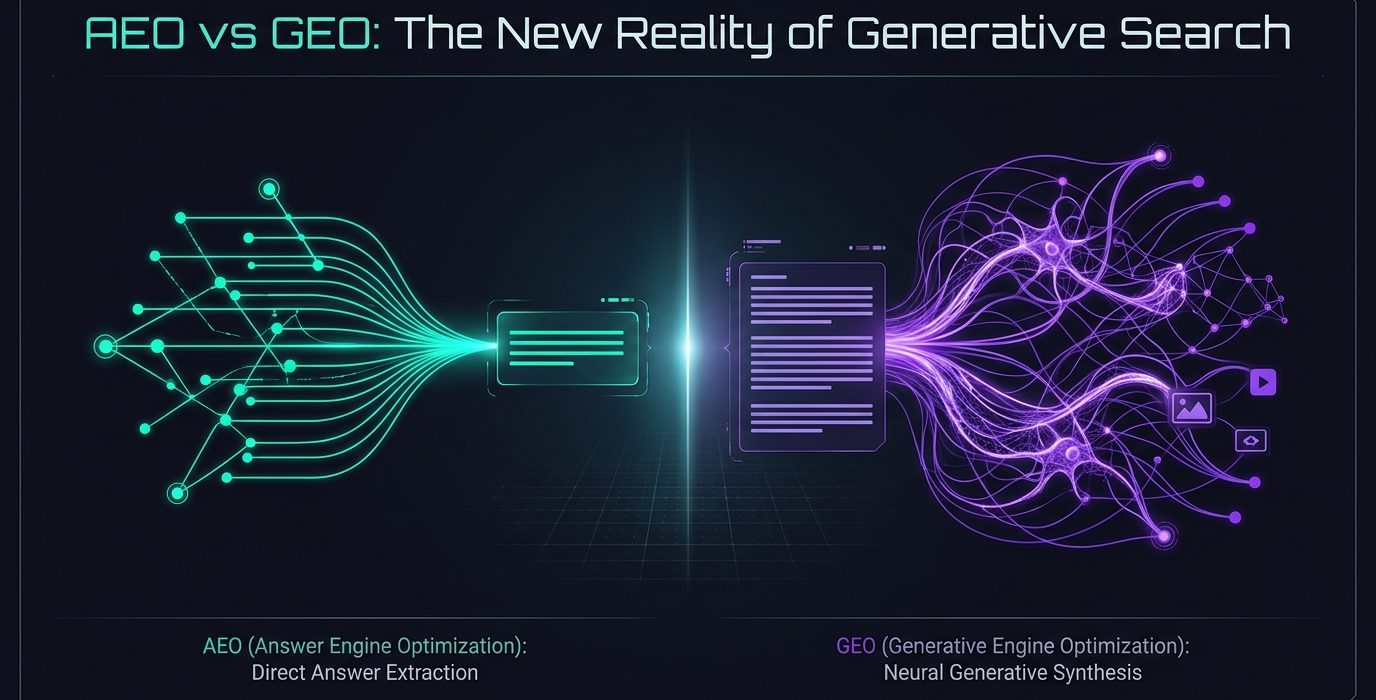
Answer Engine Optimization (AEO) focuses on structuring content so search engines can extract singular direct answers for featured snippets and voice assistants, whereas Generative Engine Optimization (GEO) focuses on multi-source factual synthesis, brand citations, and multimodal inclusion inside AI models like Google AI Overviews, Perplexity, and ChatGPT Search. Both represent fundamental shifts from traditional keyword-matching algorithms.
As the digital marketing landscape adapts to artificial intelligence, consultants have flooded the market with contradictory definitions. Understanding the technical divergence between AEO and GEO is essential for brands that want to protect their search visibility without purchasing repackaged content audits.
The Technical Distinction: Extraction vs. Synthesis
The difference between AEO and GEO comes down to how retrieval systems process retrieved documents:
| Dimension | Answer Engine Optimization (AEO) | Generative Engine Optimization (GEO) |
|---|---|---|
| Core Mechanism | Passage retrieval & direct extraction | Multi-document retrieval-augmented generation (RAG) |
| Primary Target | Google Featured Snippets, Siri, Google Assistant | Google AI Overviews, ChatGPT Search, Perplexity AI |
| Ideal Formatting | 40-word declarative answer definitions | Factual density, original statistics, and comparative tables |
| Citation Value | Captures the direct click if curiosity remains | Earns unlinked brand citations and high-intent referral visits |
How Generative Engine Optimization (GEO) Evaluates Sources
Unlike traditional search engines that rank single URLs in isolation, generative engines construct a composite answer by reading multiple indexed sources simultaneously. According to research on Google AI Search Optimization, generative models select citation sources based on three primary signals:
- Information Gain: Does this article provide new data points, first-hand perspectives, or pricing tables not found in top-ranking competitors?
- Entity Disambiguation: Are brand facts and author credentials explicitly marked up via Schema.org Article vocabulary?
- Extractable Syntax: Is the text structured in concise Subject-Predicate-Object sentences that language models can quote without hallucination risk?
For actionable steps on formatting your articles for this extraction, explore our blueprint on structuring content for Google AI Overviews.
The Business Impact: Adapting to Zero-Click Realities
Informational queries are increasingly absorbed by the search engine itself. A user searching “what is AEO” will read the summary and leave without clicking. As we analyzed in our breakdown of what a Google ranking is worth, marketing teams must shift their attention toward commercial and transactional queries where users must click through to execute transactions.
Frequently Asked Questions
Do we need separate plugins for GEO or AEO?
No. Beware of plugins promising automated “AI Search rankings.” Google’s ranking systems evaluate clean HTML crawlability and content authenticity, not proprietary third-party metadata.
Can structured data alone get you cited in AI Overviews?
Structured data clarifies meaning, but it does not substitute for original insight. It confirms to the machine what the page contains, but the quality of the underlying analysis dictates whether you earn the citation.
Conclusion
AEO and GEO are not replacements for search engine optimization; they are the natural evolution of semantic search. By answering user questions directly and providing original data, your site remains indispensable to both human readers and AI crawlers. Explore our advanced SEO services or contact our team for a complimentary search audit.
[…] Fast indexing and eligibility for AEO & GEO citation features […]