
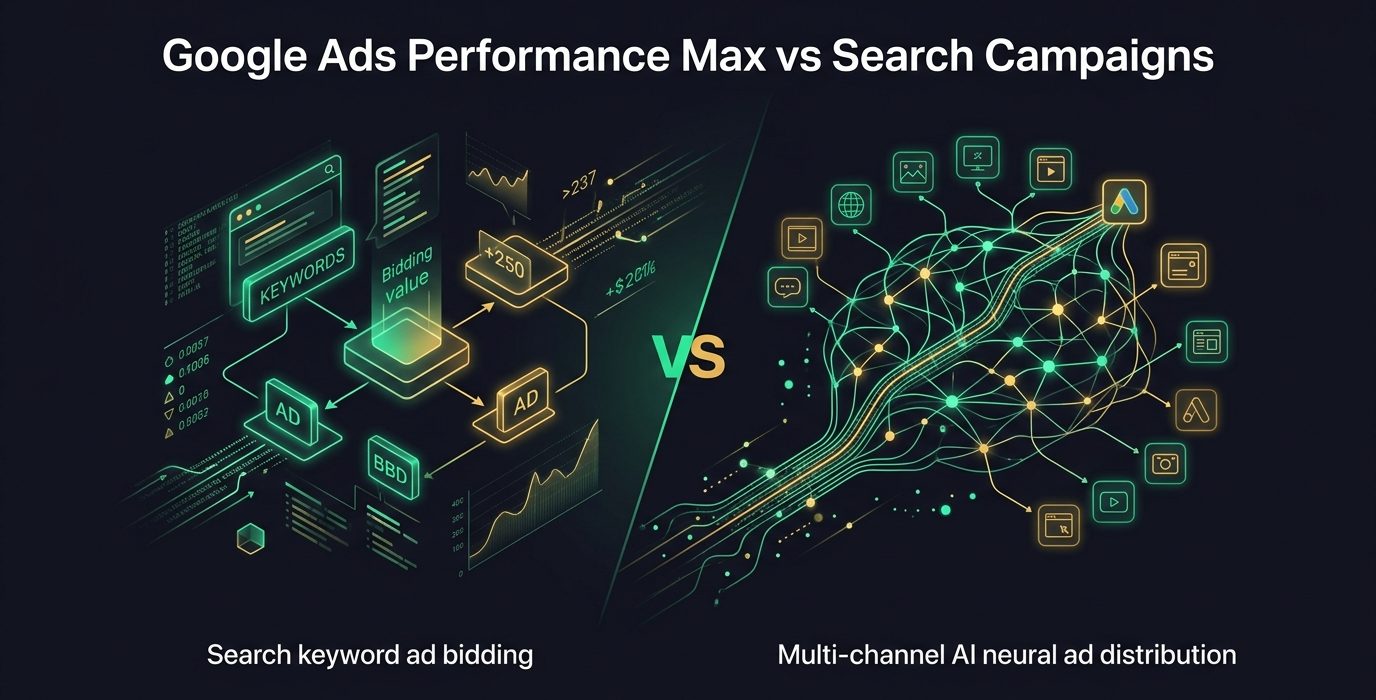
For businesses operating with a modest budget under $2,500 monthly, tightly controlled Google Search Campaigns with Exact and Phrase match keywords consistently outperform Performance Max (PMax). While PMax utilizes powerful machine learning across YouTube, Display, Discover, and Search, it requires significant data volume and budget liquidity that small campaigns cannot sustain without wasting capital on unqualified display clicks.
Google’s algorithm aggressively pushes advertisers toward automated campaign types like Performance Max. For enterprise brands spending $50,000 monthly, PMax uncovers incremental audience pockets across multiple channels. However, for a small business or regional firm, allowing an AI black box to distribute limited funds across untargeted mobile app banners and low-intent YouTube placements is a recipe for budget exhaustion.
The Structural Divergence: Control vs. Automation
To invest capital prudently, advertisers must understand how Search and PMax fundamentally differ in execution and budget consumption:
| Campaign Feature | Manual / Standard Search Campaigns | Performance Max (PMax) |
|---|---|---|
| Placement Control | 100% Google Search SERP and partner search | Black-box mix: Search, YouTube, Gmail, Display, Maps |
| Keyword Precision | Strict Exact and Phrase match targeting | Audience signals with automated algorithmic expansion |
| Budget Efficiency (<$2.5k/mo) | High: Every dollar bids directly on active search intent | Poor: Capital frequently dissipates into cheap display inventory |
| Negative Keyword Control | Full account and campaign level negative lists | Restricted; requires Google rep support or account-level lists |
Why PMax Struggles on Limited Budgets
Performance Max relies on reinforcement learning. Google’s neural models test hundreds of audience and placement combinations before identifying the optimal conversion path. According to official guidelines in Google Ads Performance Max Best Practices, campaigns require at least 30 to 50 conversion events per month just to complete the algorithmic learning phase.
If your budget only supports 15 conversions a month, PMax remains trapped in perpetual learning. The algorithm hunts for cheap impressions to meet artificial daily spend goals, which almost invariably channels your money into accidental clicks on mobile gaming apps rather than active buyers searching for solutions.
The 3-Step Strategy to Dominate on a Small Budget
1. Restrict Placements to High-Intent Search
Launch dedicated Search campaigns targeting high-intent commercial queries. If you offer web design, avoid broad searches like “web design ideas” and bid strictly on transactional intent like “B2B web design agency pricing”. As we demonstrated in our guide to running Google Ads on a small budget, precision beats volume every time.
2. Build an Aggressive Negative Keyword Wall
Uncheck “search partners” and “display expansion” on your search campaigns, and immediately apply a comprehensive negative keyword list eliminating terms like “free”, “jobs”, “templates”, and “DIY”. This ensures not a single penny of your daily budget is wasted on zero-intent traffic.
3. Coordinate Paid Search with Organic Authority
Paid advertising should never operate in isolation. Use paid search to harvest immediate high-intent buyers while building an organic semantic SEO footprint. When prospects see your brand dominating both the sponsored ad slot and the organic knowledge panel, your click-through and conversion rates compound dramatically, reducing your blended customer acquisition cost (CAC).
Frequently Asked Questions
When is a business ready to scale into Performance Max?
Transition into PMax when you achieve at least 50 reliable conversion actions per month from standard Search, have established first-party conversion tracking, and can commit a dedicated test budget of at least $100 per day without risking core search profitability.
Does Google favor PMax campaigns over Search in ad auctions?
If an Exact Match search keyword matches a search query identically, Google prioritizes the standard Search campaign over PMax. However, for Phrase and Broad match queries, PMax may take precedence if its Ad Rank is higher.
Conclusion
Automation is powerful, but disciplined control preserves capital. On small and medium budgets, standard Google Search campaigns remain the gold standard for predictable customer acquisition. Need an expert eye on your ad spend? Explore our dedicated paid advertising management services or request a free Google Ads account audit today.
Leave a Reply